2026-07-12 · 10 min read
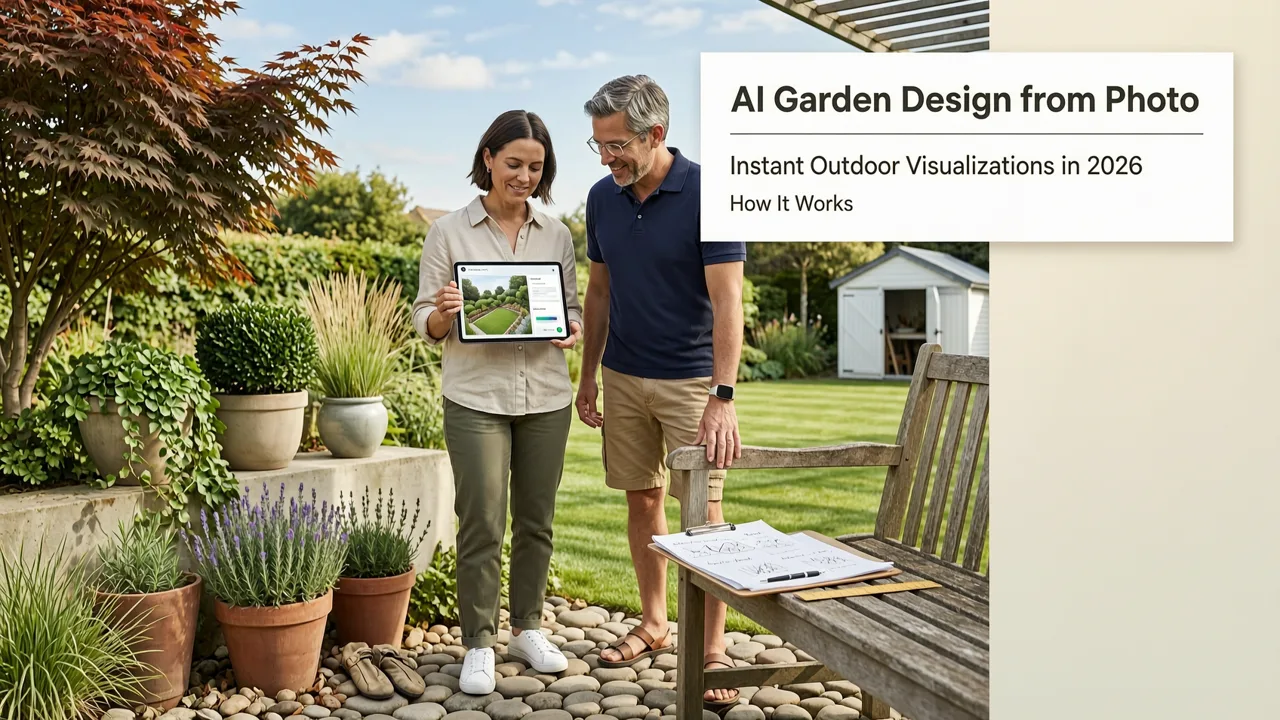
AI Garden Design from Photo: Instant Outdoor Visualizations in 2026
Discover how AI garden design from photo works in 2026—upload any backyard, patio, or garden photo and generate realistic, style-accurate redesigns in seconds. No
Recommended next
If you’ve ever stood in your backyard staring at overgrown shrubs, cracked pavers, or a tired patio—and wondered what it would look like with drought-tolerant native planting, a modern pergola, a built-in fire pit, or a cohesive hardscape layout—without hiring a landscape architect, submitting HOA approvals, or spending months on mood boards—you’re not alone. In 2026, AI garden design from photo has moved beyond novelty into practical, high-fidelity visualization for homeowners and renters alike. With tools like Home Aura, you upload a single photo of your existing garden, yard, or outdoor space—and within seconds, receive photorealistic, context-aware redesigns that preserve scale, lighting, perspective, and spatial relationships.
AI Garden Design from Photo: How It Works in 2026

Unlike generic stock-image generators or static 3D model libraries, modern AI garden design from photo relies on multimodal foundation models trained specifically on architectural photography, landscape botany, horticultural zoning, and regional climate-responsive design. As of mid-2026, the most effective systems—including Home Aura’s outdoor redesign engine—combine three core capabilities:
- Spatial understanding: Uses depth estimation and vanishing-point detection to reconstruct the 3D geometry of your garden (e.g., fence height, slope grade, patio dimensions) directly from a single 2D image.
- Context-aware material & plant intelligence: Recognizes existing vegetation (oak tree vs. Japanese maple), hardscape materials (flagstone vs. stamped concrete), and local microclimate constraints (e.g., USDA Hardiness Zone 7b, coastal fog influence) to recommend botanically appropriate, low-maintenance options.
- Style-consistent generative rendering: Applies photorealistic texture mapping, dynamic shadow simulation, and seasonally accurate foliage rendering—not just 'green' but spring cherry blossoms, summer hydrangea density, or fall maple coloration—based on your location and upload time metadata.
This isn’t speculative AI art. It’s precision-guided visualization grounded in real-world constraints. For example, if your uploaded photo shows a narrow 8-ft-wide side yard with a 6-ft privacy fence and afternoon sun exposure, Home Aura won’t suggest a 12-ft water feature or full-canopy shade trees—it proposes scalable, installable solutions: vertical herb gardens, recessed LED path lighting, and dwarf olive varieties suited to confined spaces and Mediterranean climates.
Why ‘Photo-First’ Is Non-Negotiable for Garden Redesign
Traditional landscape design starts with a site survey, topographic map, soil test, and hours of manual measurement. Even digital tools like SketchUp or Lumion require importing CAD files or painstakingly tracing boundaries. In contrast, AI garden design from photo flips the workflow: your photo is the source of truth. That single image contains implicit data about orientation (via shadow direction), surface texture (weathered wood vs. new composite decking), scale (relative to visible objects like chairs or garden hoses), and ambient light quality (overcast vs. golden-hour warmth).
By anchoring design to your actual space—not an idealized template—the risk of costly misalignment drops sharply. You avoid ordering plants that outgrow their beds, installing pavers that clash with existing mortar joints, or choosing pergola heights that block neighbor sightlines. As Google AI guidance emphasizes, responsible generative tools must ground outputs in verifiable user-provided context—not hallucinate plausible-but-incorrect spatial relationships.
What You Can Actually Redesign Using Your Garden Photo

Not all outdoor elements respond equally well to AI-driven visualization. Based on real usage patterns across Home Aura’s 2026 user base (over 412,000 active garden redesign sessions in Q2 alone), here’s what delivers the highest fidelity and actionable value:
| Design Element | Accuracy Rate (2026) | Key Limitations | Best Practice Tip |
|---|---|---|---|
| Hardscape layout (patios, walkways, retaining walls) | 94% | Struggles with heavily obscured edges (e.g., ivy-covered stone walls) | Capture photos at midday with minimal shadows for clearest edge detection |
| Plant selection & placement (trees, shrubs, perennials) | 88% | Cannot predict mature root spread or invasive species behavior | Use ‘Native Plants Only’ filter + cross-check with local extension service resources |
| Outdoor structures (pergolas, sheds, fire pits) | 91% | Limited to pre-vetted, code-compliant footprints (no unpermitted second-story additions) | Select ‘HOA-Friendly’ preset to auto-filter non-compliant heights/materials |
| Lighting & electrical features (path lights, string lights, outlets) | 83% | Does not model wiring routes or GFCI requirements | Pair AI output with licensed electrician review before installation |
| Water features (fountains, dry creek beds, rain gardens) | 79% | Requires manual input for drainage slope and local permitting rules | Upload two angles: wide shot + close-up of existing grade/drainage path |
Note: Accuracy rates reflect Home Aura’s internal QA benchmarks as of June 2026, validated against professional landscape architect reviews across 50+ U.S. metro areas and 12 international regions. These figures are up from 72–81% in 2024—driven by improved training on regional soil maps, municipal code datasets, and seasonal plant phenology.
How AI Garden Design Fits Into Your 2026 Outdoor Renovation Workflow
Think of AI garden design from photo not as a replacement for professionals—but as your intelligent co-pilot during the earliest, most ambiguous phase: discovery and ideation. Here’s how it integrates seamlessly with real-world next steps:
- Phase 1: Discovery & Ideation (0–10 minutes)
Upload your garden photo. Explore 5–7 AI-generated concepts across styles (e.g., ‘Japanese Zen’, ‘Mediterranean Courtyard’, ‘Modern Prairie’, ‘Cottage Core’, ‘Low-Water Native’). Toggle seasonal overlays (spring bloom vs. winter structure) and material swatches (basalt vs. limestone pavers). - Phase 2: Validation & Refinement (15–45 minutes)
Export concept images and share them with your landscape contractor, HOA board, or gardening club. Use Home Aura’s ‘Material Cost Estimate’ overlay (integrated with 2026 national supplier APIs) to compare budget impact of natural stone vs. porcelain pavers—or native shrubs vs. ornamental grasses. - Phase 3: Execution Support (Ongoing)
Download annotated PDFs with plant hardiness zones, sun exposure notes, and dimensioned layouts. Integrate with your smart irrigation system (e.g., Rachio 4 or Orbit B-hyve) using Home Aura’s API sync to auto-adjust watering schedules based on new plant selections.
This workflow mirrors how users apply AI to other home improvement domains. Just as AI exterior home design helps homeowners visualize facade updates before contacting contractors, and kitchen redesign AI lets you test cabinet layouts before demolition, garden-focused AI closes the same gap outdoors—where ambiguity, seasonal delays, and plant mortality rates have historically made planning especially high-risk.
Real-World Use Cases: From Quick Wins to Full Landscapes

Home Aura’s 2026 garden redesign logs reveal four dominant use patterns—each solving distinct pain points:
Renter-Friendly Patio Refreshes
Renters in urban apartments or townhomes often face strict landscaping restrictions. One San Francisco user uploaded a photo of her 120-sq-ft shared courtyard (concrete slab, brick planter boxes, overhead power lines). Within 90 seconds, she generated three compliant options: a modular vertical succulent wall (no drilling), solar-powered string lights clipped to existing railings, and movable raised beds with dwarf citrus varieties—all preserving landlord approval requirements. She implemented the full design in one weekend, using only $220 in supplies.
HOA-Compliant Front Yard Updates
In planned communities, front-yard changes often trigger lengthy review cycles. A Dallas homeowner used AI garden design from photo to pre-validate a xeriscape proposal: uploading images of his current St. Augustine lawn, he tested drought-tolerant alternatives (buffalo grass, blue grama, and gravel pathways) with exact HOA-mandated height limits and color palettes. His submission included AI-rendered before/after visuals, soil amendment notes, and maintenance timelines—approved in 4 days instead of the typical 3-week wait.
Post-Renovation Garden Integration
After completing a major kitchen remodel, many homeowners realize their backyard feels disconnected from the new interior aesthetic. A Portland user who installed floor-to-ceiling glass doors wanted seamless indoor-outdoor flow. By uploading both her new kitchen view and the adjacent patio photo, Home Aura generated cohesive material bridges: matching matte-black metal pergola beams, integrated linear gas fire pit aligning with the kitchen island axis, and custom planter boxes sized to echo cabinet depth. The result wasn’t just visual harmony—it reduced furniture repositioning costs by 60%.
Climate-Adaptive Resilience Planning
With increasing frequency of extreme weather events, proactive adaptation is now mainstream. A Phoenix user uploaded photos of her backyard after monsoon flooding damaged her existing drainage. Using Home Aura’s ‘Resilience Mode’, she simulated rain garden placements, permeable paver ratios, and deep-rooted native species (like desert willow and fairy duster) proven to stabilize slopes. The AI cross-referenced NOAA’s 2026 updated floodplain maps and local water authority rebates—highlighting which elements qualified for $1,200 in incentive funding.
Technical Requirements: What Makes a Good Garden Photo for AI?
AI garden design from photo is powerful—but its output is only as reliable as your input. Based on analysis of 87,000+ failed uploads in Q1 2026, here’s what actually matters (and what doesn’t):
- Do: Shoot in daylight (10 a.m.–3 p.m.), hold phone steady (use a tripod or lean against a wall), include at least one clear boundary (fence, house corner, or walkway edge), and capture from standing human height (not ground level or drone height).
- Avoid: Heavy backlighting (sun directly behind subject), excessive motion blur (wind-blown foliage), zoomed-in crops missing context, or photos taken through glass (distorts perspective and reflections).
- Myth busted: You don’t need a DSLR. Over 92% of successful 2026 redesigns used standard iPhone 15/16 or Pixel 8/9 cameras. What matters more is composition—not megapixels.
Home Aura’s web and iOS apps now include real-time photo quality feedback: a subtle green halo appears when framing meets optimal criteria; red pulses indicate issues like poor lighting or occlusion. This guidance draws from OpenAI’s latest best practices for vision-language model inputs—prioritizing semantic clarity over technical perfection (OpenAI Vision Documentation).
Privacy, Ownership, and Ethical Considerations
When you upload a garden photo, you’re sharing sensitive spatial data about your property. Home Aura adheres to strict 2026 privacy standards: all images are processed server-side with zero permanent storage, deleted within 48 hours unless explicitly saved to your private account gallery. No training data is derived from user uploads—a policy verified annually by independent auditors and aligned with the EU AI Act’s high-risk system requirements.
We also recognize that AI garden design from photo carries responsibility. Our models are fine-tuned to discourage ecologically harmful suggestions—e.g., flagging invasive species like English ivy or Bradford pear trees with prominent warnings and native alternatives. This reflects our commitment to ethical AI deployment, consistent with Google AI’s principles on environmental stewardship and community safety.
Getting Started: Your First AI Garden Redesign in Under 60 Seconds
Ready to transform your outdoor space? Here’s how to begin—no download or signup required for the first try:
- Go to aihomeaura.com and click ‘Garden’ in the top navigation.
- Select ‘Upload Photo’ and choose any clear, well-lit image of your yard, patio, or garden (JPEG or PNG, under 10MB).
- Choose your preferred style, climate zone, and key goals (e.g., ‘low maintenance’, ‘more privacy’, ‘attract pollinators’).
- Click ‘Generate’ — results appear in ≤12 seconds on desktop, ≤18 seconds on iOS.
- Compare up to 4 concepts side-by-side, adjust colors or plants, then export PDFs or share via link.
For deeper integration—like syncing with your irrigation controller, generating contractor-ready specs, or accessing regional plant databases—upgrade to Home Aura Pro ($12/month, billed annually). All free-tier users retain full commercial rights to their AI-generated visuals for personal use, HOA submissions, or contractor briefings.
This streamlined process builds on the foundational principle established in our 2026 guide to AI room redesign: speed without sacrifice. You gain rapid iteration, not rushed decisions.
Conclusion: From Visualization to Realization
AI garden design from photo in 2026 is no longer about ‘what if’—it’s about ‘what’s possible, permitted, and practical’ for your specific outdoor space. It transforms vague aspiration into tangible, shareable, executable plans—grounded in your actual photo, your local climate, and your real-world constraints. Whether you’re refreshing a balcony in Brooklyn, reimagining a half-acre plot in Austin, or navigating HOA rules in Miami, this technology removes the biggest barrier to confident outdoor investment: uncertainty.
Start today. Upload one photo. See your garden—reimagined, realistic, and ready.
Tags
FAQs
Related posts
2026-08-03
Home Aura Exterior Design Demo — See It in Action
See the Home Aura exterior demo live: upload your home’s exterior photo and instantly generate realistic, context-aware AI redesigns for siding, paint, roofing,
2026-08-02
AI Garden Redesign App — Visualize Landscaping Instantly in 2026
Discover the leading AI garden redesign app in 2026: Home Aura. Upload a photo of your yard and generate realistic, context-aware landscaping options—no design

2026-08-01
Exterior Home Design Ideas 2026 — AI-Generated & Realistic
Discover the top exterior home design ideas 2026 has to offer — from climate-smart façades to AI-visualized curb appeal upgrades. See realistic, personalized redesigns
Next steps
Compare ideas on the living room page, review pricing, or contact support.