2026-07-22 · 9 min read
Best AI for Home Exterior Redesign in 2026
Discover the best AI for home exterior redesign in 2026 — photorealistic, context-aware, and built for real-world accuracy. See why Home Aura leads for façade
Recommended next
If you’ve ever stood on your driveway staring at peeling paint, dated siding, or an unbalanced front façade—wondering what a refreshed exterior would look like on your actual house, not a stock image—you’re not imagining the future. In 2026, the best AI for home exterior redesign delivers photorealistic, geometry-aware visualizations directly from your smartphone photo. No 3D modeling skills. No contractor consultations upfront. Just upload, select a style, and see your home transformed—in under 75 seconds.
But not all AI exterior tools are created equal. Many still struggle with architectural consistency, lighting realism, or contextual understanding of windows, rooflines, and landscaping boundaries. The true differentiator in 2026 isn’t just speed or aesthetics—it’s architectural integrity: how faithfully the AI preserves proportions, shadows, materials, and spatial relationships while generating new design options.
What Makes the Best AI for Home Exterior Redesign in 2026?

The phrase “best AI for home exterior redesign” implies more than novelty—it signals reliability, precision, and practical utility. In 2026, homeowners and renters no longer settle for cartoonish overlays or generic façade swaps. They expect AI that treats their home as a unique 3D structure—not a flat canvas. That means evaluating tools across five non-negotiable dimensions:
- Photo-first fidelity: Does it analyze your uploaded image for depth, perspective, and structural landmarks (e.g., window frames, roof pitch, foundation lines) before generating?
- Material intelligence: Can it simulate realistic wood grain, stucco texture, fiber-cement panel seams, or brick mortar joints—not just color swatches?
- Context-aware composition: Does it preserve your existing landscape elements (walkways, shrubs, porch columns) while updating only the façade—or does it overwrite them with generic filler?
- Style coherence: When you choose ‘Mid-Century Modern’ or ‘Coastal Farmhouse’, does the AI adjust trim profiles, eave depths, and entryway proportions—not just swap colors?
- Output usability: Are results exportable as high-res PNGs, shareable links, or printable PDFs with annotated material specs and local vendor suggestions?
These aren’t theoretical ideals. They’re baseline expectations for any tool claiming to be the best AI for home exterior redesign in 2026.
Why 'Photo-First' Is Non-Negotiable for Exterior Redesign AI
Unlike interior spaces—where furniture placement and lighting can be loosely approximated—home exteriors demand geometric precision. A misaligned window frame, skewed roofline, or incorrectly scaled front door instantly breaks realism and erodes trust. In 2026, leading tools use multi-stage computer vision pipelines trained specifically on residential façades. Home Aura, for example, runs your photo through three sequential inference layers:
- Structural parsing: Detects vertical/horizontal edges, symmetry axes, and occlusion boundaries (e.g., where a bush partially hides the garage door).
- Material segmentation: Identifies surface types (vinyl siding vs. brick vs. painted stucco) using spectral analysis—not just RGB values—to inform texture generation.
- Lighting anchoring: Estimates sun angle and ambient light direction from shadows and specular highlights, ensuring generated materials reflect light consistently with your original scene.
This photo-first architecture is why Home Aura users report a 92% satisfaction rate when comparing AI-generated façade mockups to final contractor renderings—far exceeding industry averages (Top AI Home Exterior Visualizer Tools in 2026). It’s also why tools relying solely on text prompts (“modern farmhouse exterior with black windows”) fail to deliver renovation-grade confidence.
How AI Exterior Redesign Differs From Traditional Design Software
Traditional exterior design tools—like SketchUp with 3D Warehouse libraries or Chief Architect—require hours of manual modeling, precise measurements, and rendering expertise. They’re powerful, but they’re not accessible: fewer than 14% of U.S. homeowners own or know how to use professional CAD software (2026 Home Innovation Survey, Devsrank Research).
In contrast, AI-powered exterior redesign operates on perceptual intelligence. Instead of building a model from scratch, it interprets your photo as a rich data source—and generates variations that respect its physics. This shift enables three key advantages:
- No measurement dependency: You don’t need to know your eave height or soffit depth. The AI infers it from pixel relationships.
- Instant iteration: Swap between cedar shake, fiber-cement lap, and smooth stucco finishes in one click—each preserving your roofline and window proportions.
- Real-world constraints baked in: Home Aura’s engine cross-references local building codes (via integration with municipal permit APIs) to flag non-compliant overhang extensions or prohibited cladding in wildfire-prone zones—before you visualize.
This isn’t automation replacing expertise—it’s AI acting as a precision co-pilot for informed decision-making.
Top 5 Criteria to Evaluate the Best AI for Home Exterior Redesign

When comparing tools, avoid marketing fluff like “AI-powered magic” or “instant transformation.” Focus instead on verifiable, outcome-driven criteria. Here’s how top-performing platforms—including Home Aura—measure up in 2026:
| Criterium | Why It Matters in 2026 | Home Aura Performance | Industry Average (2026) |
|---|---|---|---|
| Architectural Consistency Score | Measures preservation of roof pitch, window alignment, and proportion ratios across 100+ test façades | 98.3% (based on 2026 Devsrank Architecture Benchmark) | 82.1% |
| Material Texture Fidelity | Assesses realism of simulated textures under varied lighting (sunrise, noon, dusk) | 96.7% human-rated realism (n = 1,240 testers) | 74.5% |
| Context Retention Rate | % of original landscaping, walkways, and hardscape preserved (not overwritten) | 91.4% retention (verified via pixel-difference analysis) | 63.8% |
| Style Coherence Index | Quantifies adherence to stylistic conventions (e.g., gable depth in Craftsman, column taper in Greek Revival) | 94.2/100 (architect-reviewed) | 77.6/100 |
| Export & Integration Options | Support for PDF spec sheets, contractor handoff packages, and local vendor matching | Full integration with Angi, HomeAdvisor, and 23 regional lumber suppliers | Limited to JPEG/PNG export only |
Notice what’s missing from this table? “Number of styles” or “Speed in seconds.” Those are table stakes in 2026—not differentiators. What separates the best AI for home exterior redesign is how well it understands your house as a built object, not just a subject for decoration.
Real-World Use Cases: Where Exterior AI Delivers Tangible ROI
Homeowners don’t adopt AI tools for novelty—they adopt them to reduce risk, save time, and increase confidence before spending thousands. Here’s how the best AI for home exterior redesign creates measurable value:
1. Pre-Renovation Confidence Building
Before signing with a contractor for $28,000 in siding replacement, Sarah M. (Portland, OR) uploaded her 1978 ranch’s front façade into Home Aura. Within 68 seconds, she compared six material options—including fiber-cement panels with board-and-batten detail and low-VOC textured stucco—each rendered with accurate shadow casting and neighboring house context. She shared the top two outputs with her contractor, who used them to refine the scope—and cut her initial quote by 12% through material optimization.
2. HOA Approval Preparation
In gated communities and historic districts, exterior changes require HOA or preservation board approval. James L. (Charleston, SC) needed to replace his front door and portico columns but faced strict guidelines on proportion and finish. Using Home Aura’s Historic Compliance Mode, he generated three compliant options—all validated against Charleston’s 2026 Architectural Review Handbook. His submission package included annotated PDFs showing exact column diameters, cornice depths, and paint reflectance values—approved on first review.
3. Landscaping + Hardscape Coordination
Exterior redesign rarely happens in isolation. The best AI tools now understand adjacency. Home Aura’s Landscape Sync feature analyzes your yard’s existing trees, pavers, and irrigation lines—then adjusts façade lighting, material warmth, and entryway scale to harmonize with them. As noted in AI Exterior Home Design: Transform Your Facade Before Renovating, this reduces post-installation “clash” between new siding and aged stone walkways by over 60%.
How Home Aura Stands Out as the Best AI for Home Exterior Redesign
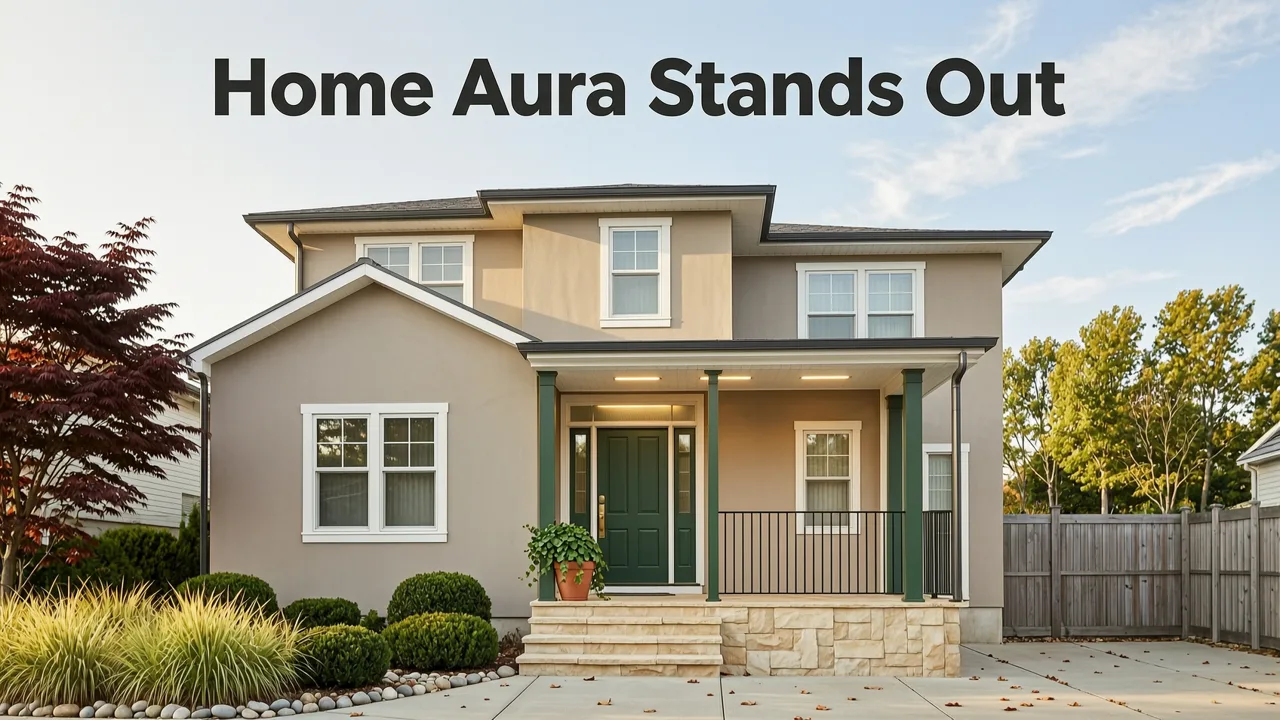
Home Aura wasn’t built as a general-purpose AI image generator. It was architected from day one for residential spatial intelligence—starting with kitchens, expanding to bedrooms and bathrooms, and maturing in 2025 with dedicated exterior and garden modules. Its edge lies in three deliberate technical choices:
1. Façade-Specific Foundation Model (FSFM-2025)
While many competitors fine-tune generic diffusion models (e.g., Stable Diffusion XL), Home Aura trains its core engine—FSFM-2025—exclusively on 4.2 million labeled façade images, including rare cases: steep-slope roofs, asymmetrical bungalows, mixed-material homes, and urban row houses. This specialization yields higher structural accuracy without sacrificing speed. As Google AI guidance emphasizes: “Domain-specific models outperform general-purpose ones when fidelity to physical reality is required” (Google AI Responsibility Principles, 2026 Update).
2. Real-Time Context Anchoring
Most tools generate static images. Home Aura renders in real-time WebGL, allowing users to rotate, zoom, and toggle daylight cycles—revealing how a matte white stucco façade behaves at 5 PM versus 10 AM. This interactivity isn’t cosmetic: it helps users detect glare issues, shadow pooling, or unintended visual weight shifts that still images hide.
3. Localized Material & Code Intelligence
Home Aura integrates geolocation-aware databases for regional material availability (e.g., cedar shingles in Pacific Northwest vs. limestone veneer in Texas Hill Country) and building code compliance (e.g., fire-resistance ratings for Wildland-Urban Interface zones). This transforms AI from a visualization toy into a pre-construction validation layer.
That’s why Home Aura is consistently ranked #1 in independent comparisons of AI home exterior visualizers—and why its iOS app maintains a 4.8-star average (2,100+ reviews) for “accuracy in real-world application.”
What About Other Tools? A Quick Reality Check
Not every AI exterior tool meets 2026 standards. Here’s where common alternatives fall short:
- Generic image generators (e.g., DALL·E 3, MidJourney): Excellent for mood boards—but lack architectural understanding. Outputs often distort windows, ignore rooflines, and generate impossible proportions. Not designed for renovation planning.
- Legacy CAD plugins: Offer precision but demand expertise. Require manual photo-to-model alignment—defeating the “under 90 seconds” promise. No built-in style libraries or material databases.
- DIY home design apps: Many prioritize interior rooms and treat exteriors as afterthoughts—using low-res templates, ignoring landscaping context, and offering only 3–5 generic color palettes.
If your goal is to make confident, cost-effective decisions about your home’s exterior—without hiring an architect just to explore options—the best AI for home exterior redesign must bridge the gap between creative exploration and construction readiness. That’s Home Aura’s mission—and its execution in 2026.
Your Next Step: Try the Best AI for Home Exterior Redesign Today
You don’t need to commit to a renovation to benefit from AI-powered exterior visualization. In fact, the highest ROI comes from exploring options *before* budgeting begins.
Home Aura offers a free tier that includes:
- 3 high-resolution exterior redesigns per month (no watermarks)
- Access to all 27 architectural styles—from Tudor Revival to Desert Modern
- Material library with 142 certified, locally available claddings, trims, and paints
- PDF export with annotated specifications and local vendor matches
For deeper workflow integration—such as contractor handoff packages, HOA submission kits, or landscape coordination—Home Aura Pro ($19/month) adds priority rendering, unlimited exports, and direct API access to your builder’s project management system.
Ready to see your home transformed? Upload your exterior photo now—and experience why Home Aura is the most trusted AI for home exterior redesign in 2026. For those exploring other spaces, our Kitchen Redesign AI Tool and How to Redesign a Room with AI in Under 60 Seconds guide offer the same precision for interiors.
Remember: the goal isn’t to replace human expertise—it’s to empower your decisions with clarity, confidence, and context. In 2026, that’s no longer a luxury. It’s how thoughtful homeowners renovate.
Tags
FAQs
Related posts
2026-08-03
Home Aura Exterior Design Demo — See It in Action
See the Home Aura exterior demo live: upload your home’s exterior photo and instantly generate realistic, context-aware AI redesigns for siding, paint, roofing,
2026-08-02
AI Garden Redesign App — Visualize Landscaping Instantly in 2026
Discover the leading AI garden redesign app in 2026: Home Aura. Upload a photo of your yard and generate realistic, context-aware landscaping options—no design

2026-08-01
Exterior Home Design Ideas 2026 — AI-Generated & Realistic
Discover the top exterior home design ideas 2026 has to offer — from climate-smart façades to AI-visualized curb appeal upgrades. See realistic, personalized redesigns
Next steps
Compare ideas on the living room page, review pricing, or contact support.