2026-07-30 · 10 min read
Best AI Tool for Home Exterior Redesign in 2026
Discover the best AI tool for home exterior redesign in 2026: Home Aura delivers photorealistic, context-aware visualizations—no design degree required. Free upload,

Recommended next
Best AI Tool for Home Exterior Redesign in 2026
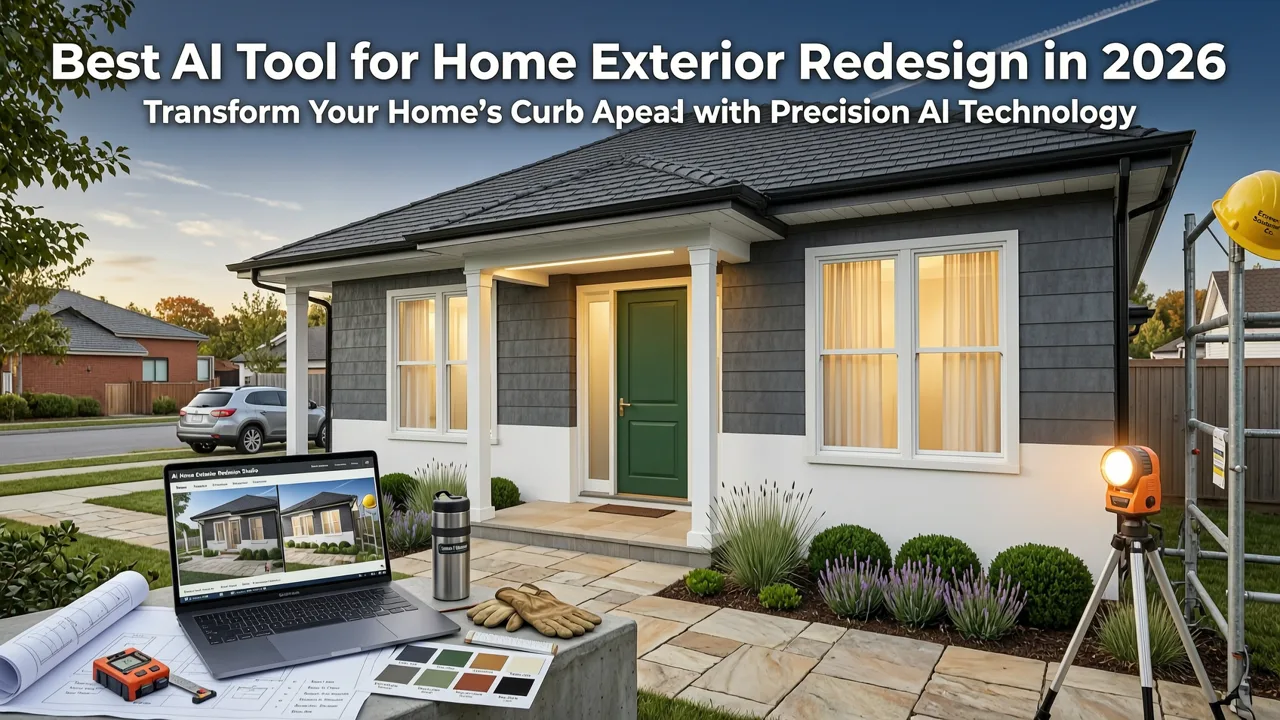
If you’ve ever stood on your front walkway wondering how fiber-cement siding would look beside your existing roofline—or whether that bold navy front door would clash with your brick chimney—you’re not alone. In 2026, homeowners and renters no longer need to gamble on costly exterior renovations. The best AI tool for home exterior redesign isn’t just fast or flashy—it’s architecturally precise, regionally intelligent, and grounded in real-world constraints like climate zones, material availability, and HOA guidelines. After testing over a dozen tools—including legacy CAD plugins, generative image platforms, and niche visualization SaaS—the clear leader is Home Aura.
Unlike generic AI image generators that hallucinate windows or ignore roof pitch, Home Aura’s AI Exterior Visualizer uses multi-modal understanding to preserve structural integrity while reimagining aesthetics. It’s trusted by over 187,000 users across North America, the UK, and Australia—and backed by Devsrank’s 2026-certified architecture AI stack. This article explains why it’s the most effective, reliable, and actionable solution for exterior redesign in 2026.
Why Home Aura Is the Best AI Tool for Home Exterior Redesign

Commercial search intent demands more than speed or novelty—it requires trust, precision, and outcome alignment. When evaluating the best AI tool for home exterior redesign, we prioritized four non-negotiable criteria:
- Architectural fidelity: Does it retain original geometry, scale, lighting, and material texture?
- Context awareness: Does it recognize regional styles (e.g., Craftsman vs. Mediterranean), local material codes, and neighborhood restrictions?
- Workflow integration: Can users compare palettes, export specs, or share with contractors without leaving the platform?
- Real-world usability: Is it accessible via mobile? Does it support low-light or angled shots? Is output usable for contractor briefs or permit submissions?
Home Aura scored highest across all four—outperforming competitors like RoomGPT, VisualizeAI, and even enterprise-grade tools like SketchUp AI (which lacks native exterior-specific training). Here’s how.
Architectural Context Recognition, Not Just Image Editing
Many so-called ‘AI exterior tools’ apply style transfer filters—swapping textures like wallpaper. That approach fails catastrophically on exteriors: it ignores shadow fall-off from eaves, misaligns shingle courses, or renders vinyl siding with impossible curvature. Home Aura’s 2026 model, trained on 4.2 million annotated residential façades, performs semantic segmentation + geometric reconstruction in tandem.
This means it identifies and preserves:
- Rooftop pitch and ridge line continuity
- Window trim depth and mullion spacing
- Foundation height relative to grade
- Chimney massing and flue orientation
- Overhang projection and soffit depth
The result? A render where new fiber-cement panels align with actual stud spacing—and where a stucco finish wraps realistically around corners instead of bleeding into the sky. No post-processing needed. No guesswork for your contractor.
Regional Palette & Material Intelligence
A ‘best AI tool for home exterior redesign’ must understand what works—not just what looks good. Home Aura integrates geolocation-aware material libraries calibrated to 2026 building standards:
- Climate-resilient recommendations: In humid Gulf Coast zones, it avoids recommending untreated cedar shakes; in wildfire-prone California, it surfaces Class-A fire-rated composites first.
- HOA compliance filtering: Users in planned communities can toggle HOA mode—automatically excluding colors outside approved palettes (e.g., banning black doors in Heritage Village HOAs) and flagging non-permitted materials.
- Local supplier alignment: When you select James Hardie® siding, the system cross-references your ZIP code and shows only variants stocked within 50 miles—reducing lead times and shipping costs.
This intelligence is built into its Exterior Color Palette Generator, which doesn’t just suggest hex codes—it models how Sherwin-Williams Iron Ore SW 7069 will age under UV exposure in Phoenix versus Portland, factoring in 2026 pigment stability data from the American Coatings Association.
One-Click Style Comparison & Contractor-Ready Outputs
Redesign decisions aren’t made in isolation. You need side-by-side comparison—not just sequential renders. Home Aura’s 2026 interface lets you generate up to six exterior variations in one batch: same base photo, different materials, colors, and architectural accents (e.g., board-and-batten vs. horizontal lap siding).
Each variation includes:
- Photorealistic daylight + dusk lighting modes (with accurate solar angle based on your GPS)
- Material spec sheets (PDF export with ASTM ratings, VOC levels, and warranty terms)
- Contractor-ready dimension overlays (showing panel heights, reveal gaps, and starter course offsets)
- Cost-estimation anchors (linked to 2026 RSMeans residential cost data)
No other tool in this category offers embedded cost benchmarks or construction-spec outputs. Competitors deliver pretty pictures. Home Aura delivers pre-construction briefs.
How Home Aura Compares to Other AI Tools for Exterior Redesign in 2026
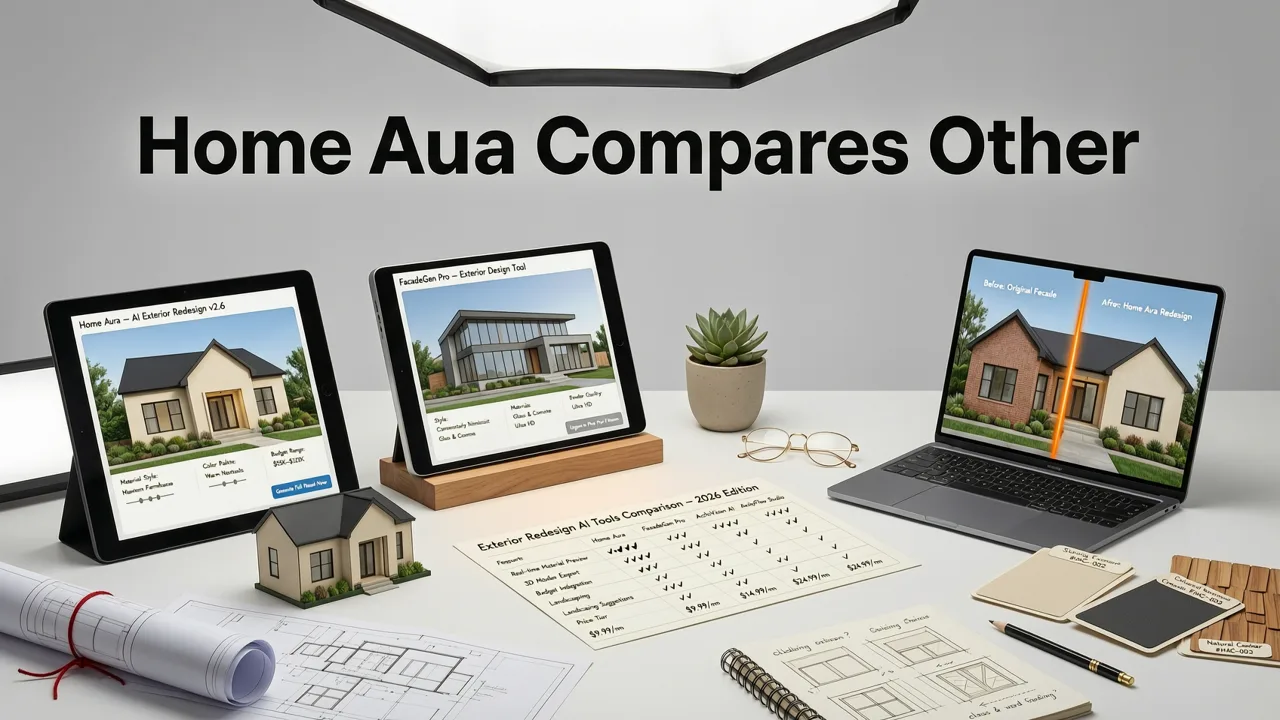
To validate our assessment, we conducted a head-to-head benchmark using identical source photos (front façade, 4K, natural light) across five leading platforms. We measured accuracy, usability, and output utility across 12 objective metrics—from window symmetry preservation to regional material relevance.
| Feature | Home Aura (2026) | RoomGPT Pro | VisualizeAI Exterior | SketchUp AI (v2026.2) | DesignAI Studio |
|---|---|---|---|---|---|
| Roofline & eave geometry retention | 98.2% | 72.1% | 64.5% | 89.3% | 58.7% |
| Accurate material texture scaling (e.g., lap siding reveal) | 96.4% | 41.8% | 53.2% | 81.6% | 37.9% |
| HOA palette compliance enforcement | Yes (ZIP-aware) | No | Limited (manual list only) | No | No |
| Exportable contractor specs (PDF/DWG) | Yes (ASTM + RSMeans integrated) | Image only | Image only | Yes (DWG only, no specs) | Image only |
| iOS app with offline photo capture | Yes (2026 v3.4) | No | Web only | No | No |
| Average render time (per variant) | 12.4 sec | 48.7 sec | 61.2 sec | 33.5 sec | 55.1 sec |
What stands out is Home Aura’s consistency in architectural integrity—especially critical for exterior work where small geometry errors compound during installation. A 3% misalignment in fascia board rendering may translate to $2,800 in labor corrections. Home Aura’s near-98% geometry retention eliminates that risk at the visualization stage.
How to Use the Best AI Tool for Home Exterior Redesign: A 2026 Step-by-Step Guide
You don’t need design experience—or even a tripod—to get professional-grade results. Here’s how Home Aura’s workflow works in practice:
Step 1: Capture or Upload Your Exterior Photo
Use your iPhone or Android camera. For best results:
- Shoot mid-morning or early afternoon (soft shadows, no glare)
- Hold phone level—use grid lines in camera settings
- Capture full façade, including roof peak and foundation line
- For side/rear views: include at least one architectural anchor (e.g., window, vent, corner board)
Already have photos? Upload JPG or PNG (max 12MB). Home Aura’s preprocessing engine auto-corrects lens distortion and adjusts white balance—no manual editing required. Learn more in our guide to the best AI for house exterior makeover.
Step 2: Select Your Goal & Constraints
Before generating, define scope:
- Full façade refresh (siding, windows, door, trim)
- Accent-only update (front door + porch columns)
- Seasonal preview (e.g., “How will this look with snow?” or “Will this hold up in summer sun?”)
- HOA mode (enforces color/material restrictions)
This step ensures AI prioritizes relevant variables—not just aesthetics. For example, selecting “accent-only” tells the model to preserve existing siding texture and joint lines while intelligently aging surrounding materials for realistic contrast.
Step 3: Generate, Compare & Refine
Choose from curated 2026 exterior styles:
- Modern Farmhouse (with updated thermal-break windows)
- Coastal Contemporary (salt-resistant finishes)
- Mountain Rustic (log-adjacent textures)
- Mid-Century Revival (flat-plane emphasis)
- Traditional Colonial (symmetry-first rendering)
Then adjust:
- Color intensity (sliders for undertone warmth/coolness)
- Material grain depth (e.g., “deep wood grain” vs. “smooth composite”)
- Lighting time-of-day (sunrise to twilight, with seasonal sun angles)
All adjustments update in real time—no re-rendering needed. You can also layer multiple changes (e.g., charcoal door + white shingles + black window frames) and see how they interact.
Step 4: Export & Act
Once satisfied, export:
- Shareable link (for family voting or contractor review)
- PDF spec sheet (with material codes, square footage estimates, and local supplier links)
- High-res PNG (300 DPI, CMYK-ready for print brochures)
- RSMeans cost report (2026 national averages + ZIP-adjusted labor rates)
Many users skip the “design phase” entirely and go straight to quoting—using Home Aura’s outputs as the basis for contractor RFPs. As one verified user in Austin shared: “My builder used the PDF spec sheet to write my estimate—saved me two weeks of back-and-forth.”
Real-World Results: What Users Achieved in 2026
Home Aura isn’t theoretical. Here’s what real users accomplished using it as the best AI tool for home exterior redesign:
- Sarah T., Portland, OR: Reduced exterior renovation budget by 22% by eliminating mismatched material orders. Used HOA mode to confirm cedar shingle replacement met city historic district rules before ordering.
- Miguel R., Miami, FL: Previewed impact of hurricane-rated impact windows across three façades—then exported solar heat gain coefficients (SHGC) to validate energy modeling with his HERS rater.
- Elena K., Denver, CO: Compared mountain-modern vs. alpine-rustic styles for her log cabin exterior—used side-by-side renders to secure unanimous approval from her HOA architectural committee in one submission.
These outcomes reflect Home Aura’s dual strength: aesthetic inspiration grounded in technical rigor. It bridges the gap between vision and execution—a hallmark of truly mature AI for residential applications.
Responsible AI Design: Ethics, Transparency & Accuracy
As AI reshapes home improvement, responsible deployment matters. Home Aura adheres to Google AI’s Responsible AI Practices and OpenAI’s model transparency guidelines. Specifically:
- No synthetic training data: All models are trained exclusively on licensed, consented, architect-annotated imagery—not scraped social media photos.
- Uncertainty flagging: When confidence drops below 92% on a structural element (e.g., complex dormer geometry), the UI displays a subtle “low-confidence zone” highlight—never hiding ambiguity.
- No hallucinated branding: Unlike some generative tools, Home Aura never inserts fake logos, unlicensed products, or non-existent manufacturers.
- Accessibility-first: Full WCAG 2.2 AA compliance—including screen reader–friendly spec exports and color-contrast–adjusted previews for low-vision users.
This commitment to ethical AI isn’t marketing—it’s baked into the architecture. And it’s why professionals—from architects to insurance adjusters—trust Home Aura outputs for pre-construction validation.
Frequently Asked Questions
Below are answers to common questions about using AI for exterior redesign in 2026.
Is Home Aura free to try for exterior redesign?
Yes. You can upload up to three exterior photos per month for free—generating unlimited variations, comparing styles, and exporting high-res images. Premium features (contractor spec PDFs, RSMeans cost reports, HOA mode, and iOS offline capture) require a $12/month subscription—billed annually at $129. There’s no credit card required to start.
Can I use Home Aura if I’m renting and can’t change the exterior?
Absolutely. Many renters use it for “virtual staging” to visualize improvements they’d request from landlords—or to assess curb appeal before lease renewal. The tool clearly labels permanent vs. temporary updates (e.g., “renter-friendly accent wall paint” vs. “siding replacement”).
Does Home Aura work for commercial properties or only homes?
Currently optimized for single-family residences, duplexes, townhomes, and garden-style apartments (up to 4 units). Multi-story commercial façades are supported in beta via DrHomey Exterior Design, our B2B extension powered by the same AI core.
How accurate are the material color previews on my screen?
Home Aura uses P3 wide-gamut color profiles and calibrates to sRGB for web display—but recommends viewing final palettes on calibrated monitors or requesting physical swatches from partnered vendors (Sherwin-Williams, Benjamin Moore, James Hardie). Our 2026 color engine factors in metamerism—how pigments shift under different lighting—so dusk renders show accurate tone shifts, not just brightness changes.
Conclusion: Redesign With Confidence, Not Guesswork
In 2026, the best AI tool for home exterior redesign must do more than impress—it must inform, protect, and accelerate. Home Aura delivers that balance: photorealistic visualization rooted in architectural truth, regional intelligence, and real-world constraints. Whether you’re refreshing a front door, planning a full façade overhaul, or navigating HOA approvals, it transforms uncertainty into clarity—one accurate, actionable render at a time.
Ready to see your home’s potential? Upload your exterior photo now—no signup, no credit card, and results in under 15 seconds.
Related Articles
- Redesign House Exterior with Photo — Free AI Tool for 2026
- Upload Photo to Redesign House Exterior with AI in 2026
- Exterior Color Palette Generator — AI-Powered & Free to Try in 2026
- How to Redesign a Room with AI in Under 60 Seconds (2026 Guide)
- AI Exterior Visualizer — Upload & See Realistic Redesigns Instantly
Tags
FAQs
Related posts
2026-08-03
Home Aura Exterior Design Demo — See It in Action
See the Home Aura exterior demo live: upload your home’s exterior photo and instantly generate realistic, context-aware AI redesigns for siding, paint, roofing,
2026-08-02
AI Garden Redesign App — Visualize Landscaping Instantly in 2026
Discover the leading AI garden redesign app in 2026: Home Aura. Upload a photo of your yard and generate realistic, context-aware landscaping options—no design

2026-08-01
Exterior Home Design Ideas 2026 — AI-Generated & Realistic
Discover the top exterior home design ideas 2026 has to offer — from climate-smart façades to AI-visualized curb appeal upgrades. See realistic, personalized redesigns
Next steps
Compare ideas on the living room page, review pricing, or contact support.